
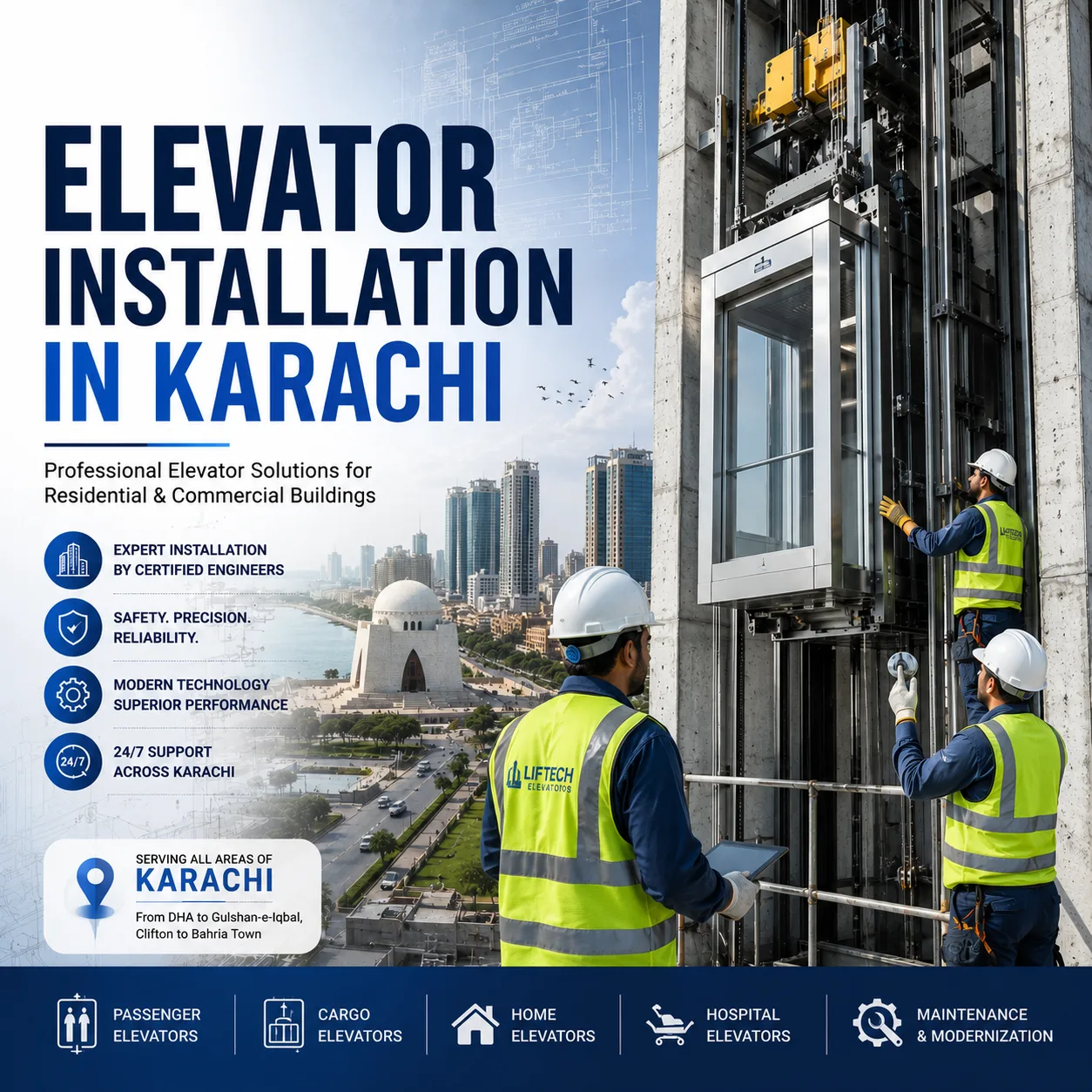
Elevator Installation in Karachi: A 2026 Engineering Guide
How Karachi's coastal climate, grid instability and high-rise construction shape elevator specification and installation.
Why Karachi is different
Karachi's coastal humidity (60–85% RH), airborne chloride, dust load and 380 V grid fluctuations demand marine-grade AISI 316 stainless finishes on ground-floor lobbies, IP55 external junction boxes, sealed door operators and VVVF drives with ±15% input tolerance. Liftech's Karachi head office specifies to these conditions by default on every passenger and cargo elevator.
What to specify
For Karachi mid-rise buildings, we recommend gearless MRL traction elevators with Torin GTW6 or Ziehl-Abegg ZAtop SM200 machines, Monarch NICE 3000+ controllers, Fuji Frenic Lift LM2A drives, ARD units sized for 30–60 minute standby, and SS 316 landing doors on ground-floor lobbies directly exposed to coastal air. Cabin package uses PVD-coated or hairline SS 304 with LED downlight and 7" TFT COP.
Rail, rope and buffer sizing
Standard passenger up to 1275 KG lands on T89 machined rails with 8×19 Seale Ø10 mm ropes at 2:1 roping. Above 1275 KG or for hospital bed lifts, upgrade to T125 rails and Ø13 mm ropes. Buffer stroke is matched to rated speed per EN 81-50 §5.5.3: 65 mm PU up to 1.0 m/s, oil buffer above 1.6 m/s.
How long installation takes
Typical 8-stop residential tower: 35–45 working days from shaft-ready date — 3–5 days scaffolding + rail plumbing, 8–12 days mechanical erection, 5–8 days wiring, 4–7 days adjustment, 2–3 days third-party 125% static / 110% dynamic load testing per EN 81-20/50.
Talk to a Liftech engineer
Have a project in Karachi? Our engineers can advise on specification, modernization or AMC.
Contact us